




Shots fired at Charles University: what will the Czech Republic do?
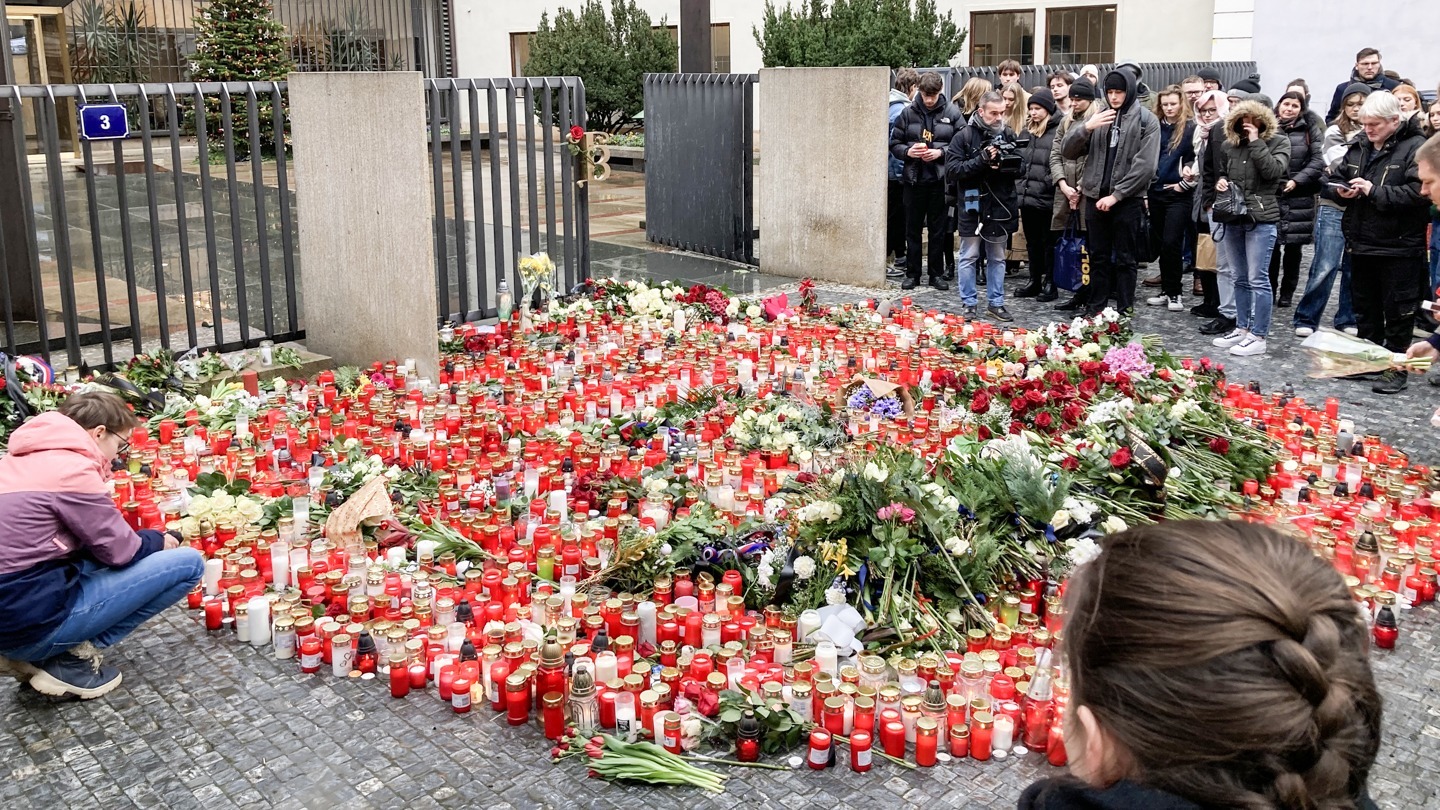
There’s no getting around it: the December 21 shooting at a Prague university is the bloodiest mass murder in modern Czech history. The killer, a twenty-four-year-old student, managed to smuggle a small arsenal into Charles University’s Faculty of Philosophy, then shot fourteen people and wounded twenty-five before taking his own life.
To say that this event shook the country is to say nothing. The Czech Republic is often listed among the safest countries in the world. And while we have had such attacks before – in 2019 with nine victims and in 2015 with eight – the attackers have never carried them out in public places so densely packed with people. (It may be noted, of course, that these previous massacres did not garner as much media attention because they did not take place in Prague, which, as every journalist and journalist knows, is the only city in the Czech Republic.) Now that the first shock and the first despair have passed, everyone is asking everyone: what next?
Think before you snap
We have some homework to do, and the first is about the media: how to talk about the perpetrator of mass murder and the motives that drove him, so as not to popularize his views? The debate on this topic recurs after every mass shooting, and its history probably goes back to the worst day in the life of mammoths 25,000 years ago, hen. However, in an era of instant connectivity at the touch of a phone, our media do not necessarily know how to deal with this.
Example: this is a fucking photo. The excellent reportage shows, as if by hand, the desperation of the students huddled on a high ledge, where the murderer might not find them. There’s just a small problem: such photographs, revealing the hiding places of potential victims, were uploaded to social media while the killer was still shooting. From there, they immediately went to news portals on the Internet before the police could even confirm that the perpetrator was dead.
I won’t pretend to know what people put in life-and-death situations have in their heads or what drives them to betray where they are hiding. Perhaps hope for a quick rescue? As journalists, however, we should have a little more oil in our heads and not hand potential victims to an armed murderer on a platter. So here’s a lesson for the media: whoever comes first is not always the most savvy. And while the Czech mainstream media has yet to explore the meaning of the word “ethics,” “endangering the lives of those involved in an incident” should sound more familiar to them. Most likely, it will not be avoided that flocks of mindless scavengers with cameras will manhandle anyone within a half-kilometer radius of the butcher’s shop and feed the gaping beaks of their public with bloody bones – but there is a time and place for that, once the immediate threat has passed. And if someone still can’t help themselves, at least don’t hint to the murderer where he will find his next victims.
Who grasps at razors
Now: how to prevent such a tragedy from happening again? Security in university buildings is basically symbolic. And while other Czech universities seem to be outdoing themselves in methods of guaranteeing student safety, it is hard not to notice that these attempts are rather lacking in seriousness. Allowing only students and university staff to enter the building looks good on paper, until one realizes that the killer was a student. Installing metal detectors at entrances is costly and requires hiring additional security personnel, and after all, it still doesn’t assure that a murderer won’t find another way inside – especially when you consider how fatally underfunded universities are under the current government.
The most frequently mentioned suggestion is, naturally, the introduction of special training for academic staff and students – only that with this it will probably be the same as with trial fire alarms: they will be immediately suppressed and forgotten. Grasping at one razor or another in this way, politicians and university authorities are totally ignoring one important little detail.
Documents, please
The killer was the legal owner of eight firearms, including four long guns. That day he equipped himself in classic fashion: with an AR-15 rifle with a scope, a favorite tool of perpetrators of massacres as far and wide as the world, and a powerful shotgun, which he eventually used on himself. We don’t know anything about anyone showing interest when they applied for a gun permit or when they bought an extremely expensive rifle. With a receipt from his family doctor and a written certificate from the police that he had no criminal record, all he had to do was pass a short exam on the use of weapons and knowledge of relevant laws. And no one even batted an eyebrow when he registered as owning seven weapons in three months. Because, you understand, there is no reason to check such cases – after all, it is known that crimes are committed only with weapons acquired illegally.
Getting a gun permit is incredibly easy in the Czech Republic – this is the grim truth. The theory exam is probably the hardest to get through, because you have to demonstrate your knowledge of the regulations on it, but such a test only excludes those who lack the self-denial to forge paragraphs on a sheet of paper. However, there is no psychological assessment of the applicant, nor is there any requirement to justify the reasons why someone is applying for a gun. All you need is some cash in your wallet.
Much of the blame for this state of affairs can be laid at the door of tradition, as arms manufacturing is one of the largest sectors of Czech industry. Behind it is a strong political lobby that has long pushed hard to make access to guns as easy as possible. But the love of shooting is also a feature of the broader society: In a country with a population of ten million, more than 300,000 people have registered a total of one million guns (2022 figures). Why do they need it? Actually, it is not known. To some, yes, guns are needed for work – foresters, for example, fall into this category (with the caveat that drunken hunters are the most common perpetrators of firearm homicides in the Czech Republic). Well, and, as far as I know, there are some athletes who actually participate in shooting competitions and similar events. However, the most commonly cited reason why people buy guns is self-defense. And it is also the most politicized cause.
If anyone in the world has heard anything about the Czech battles surrounding the right to own firearms, they may have heard about the 2021 constitutional amendment that guarantees “the right to defend one’s own life or the life of another person with a weapon.” It was pushed through by the Babiš government, and the citizens were grateful for it – for two reasons. For one thing, it dovetailed pleasantly with the (unbeknownst to me) still-coveted post-communist slogans about how “regulation is totalitarianism.” And secondly, with this one gesture Babiš showed a big facsimile to the heartless and faceless bureaucrats in Brussels. That the group of voters who support the right to own guns overlaps with the group of voters who are particularly hostile to the European Union is, of course, no revelation. Proponents of firearms, however, insist that EU attempts to limit their availability are not an effective way to combat terrorism, because terrorists obtain weapons illegally anyway – today this argument sounds particularly grim and extremely disingenuous. That said, the constitutional amendment in question didn’t really change anything in legal reality, because it also contains a brief proviso: “specific provisions shall be regulated by law.” However, the constitutional amendment sent a signal: not only is it ok to own a gun, but by going to the store to buy a rifle, you are demonstrating your rebellion. Fashion comes, fashion goes; it wouldn’t be a topic if it weren’t for the fact that these particular clothing accessories make it so much easier to kill.
What’s missing
That’s how we arrive at the central paradox of the right to own guns: the people who want to come into possession of firearms are often exactly the people who cannot be trusted in this matter under any circumstances. Platitudes about self-defense are a lame argument: defending one’s own life and property does not require pulling out a semi-automatic phallus compensator when the most dangerous thing that can come out of the woods is another ram with a shotgun. After the attack at the university, other arguments of gun advocates sound all the more hollow: “a good citizen with a gun will stop the bad guy” (and increase the number of accidental victims), “if we prohibit the possession of long guns, the bad guys will find other ways” (so the better option is to make it easier for them), “psychological tests will not detect a calculating murderer anyway” (never mind, that they will act as a deterrent and catch at least the outright miscreants), or, finally, the ever-living slogan “restricting the right to own guns is an assault on civil rights” – because a series from a rifle right in the face apparently doesn’t take away anyone’s rights. Regulations must be stricter, the path to owning a tool for killing at a distance must be longer and much more difficult, and once that happens, the weapon and its owner must be under constant surveillance.
Coincidentally, a bill on the right to own guns is currently being debated in the Czech parliament. Would you believe that the draft under discussion does not contain a single one of these solutions? The proposals so far are a disorderly muddle. On the one hand, doctors will be obliged to report suspicious patients who ask for the certificate needed to acquire weapons – which might even sound reasonable if family doctors had any psychiatric or psychological experience. On the other hand, police are to gain expanded powers to confiscate weapons from people who display “suspicious” behavior – from berating people on social media to conflicting relationships with neighbors or “ties to extremist movements.” What can go wrong? One amendment brought to the draft makes a bit of sense: ammunition dealers would be required to report customers who bought a suspiciously large number of cartridges. This will sniff out potential murderers with no more than two brain cells, but it’s always better than nothing. And it will certainly do more good than the Interior Minister’s call to refrain from setting off fireworks on New Year’s Eve, given the trauma of the students and families of the victims.
This one is immediately apparent that he knows what is important in life.
Funded by the European Union. The views and opinions expressed are those of the authors and do not necessarily reflect the views of the European Union or the Directorate General for Economic and Financial Affairs. Communication Networks, Content and Technology. Neither the European Union nor the funding body is responsible for them.